In large facilities—from hospitals, airports and universities to corporate campuses—critical IT equipment rarely sits in a single, well-staffed data center. Instead, vital network switches, servers, and security devices are spread across dozens of smaller, unmanned distributed IT rooms and equipment closets. Relying on traditional monitoring for these scattered assets is costly, complex, and dangerously reactive.
The solution lies in a convergence of advanced Agile Predictive Monitoring (AgPM) platforms and cutting-edge long-range wireless IoT networks, which together revolutionize how enterprises manage their infrastructure.
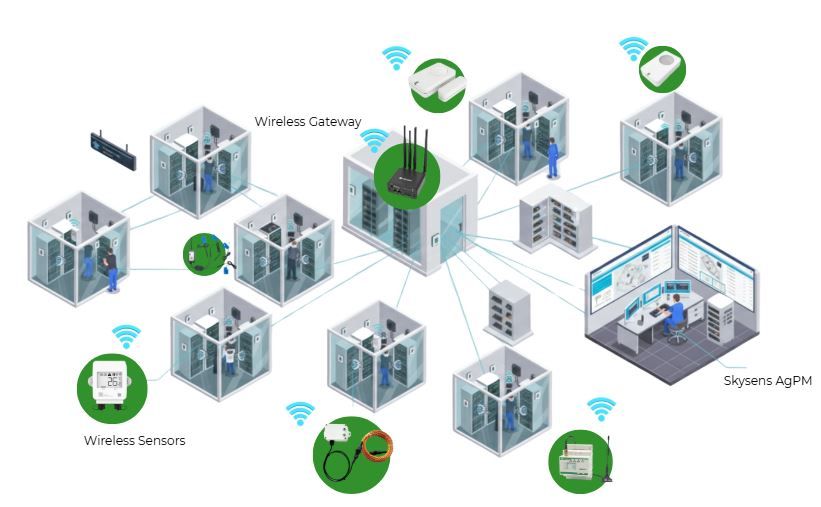
The Foundation: A Long-Range, Independent Wireless Network
Standard monitoring often involves hard-wiring sensors (via Ethernet or dedicated cables) to an existing network, a practice that is time-consuming, expensive, and disruptive, especially across business and dynamic facilities.
The Skysens approach leverages long-range wireless technology, such as LoRaWAN, to overcome these hurdles:
1-Kilometer-Scale Coverage: LoRaWAN’s exceptional range means a single gateway can cover vast areas, including multiple buildings or multiple floors, drastically simplifying network infrastructure for distributed sites.
2-Plug-and-Play Deployment: Sensors are plug-and-play, requiring no complex wiring or network configuration. This easy application cuts deployment time from weeks to days and enables facility managers to quickly scale monitoring to every remote closet.
3-Sensor Independency: The small, battery-powered sensors operate with extreme efficiency, often lasting for years. Crucially, they are independent of the IT equipment's power and network, ensuring environmental or power failure data is captured and transmitted even during a total local outage. This is vital for maintaining continuous temperature monitoring in remote rooms.
4-Open Source Nature of Hardware: LoRaWAN devices are open source in nature and many global brands are manufacturing compatible sensors globally.Due to this, it is very easy to extend the system with different types and brand hardware with very low cost.
5-IP-free network topology: LoRaWAN do not require IP connection for every end device (A.K.A. sensors) but only for gateways. This means eventhough hundreds and thousands of endpoints being monitored only couple of gateways are needed to be monitored and managed.
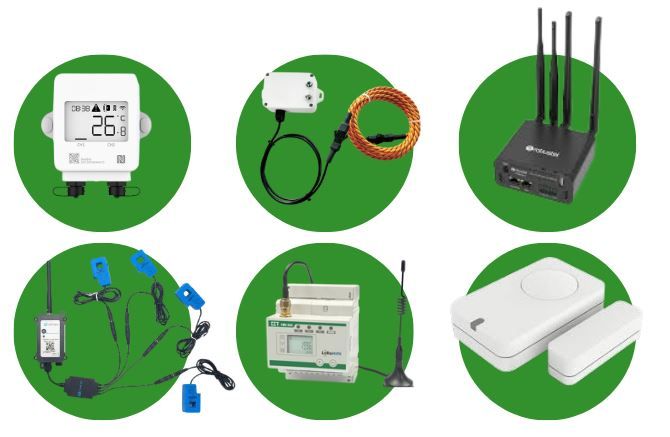
6-Different types of sensors: Available sensors are including but not limited to temperature, humidity, light, noise, water leakage, current, energy quality and consumption, door open/close, motion, presence and many more.
The Intelligence: AgPM’s Optimization Capabilities
The true power emerges when this rich, real-time data is ingested by the Agile Predictive Monitoring (AgPM) platform. AgPM is designed to be hardware-agnostic, supporting an immense sensor variety from a single interface. This includes crucial inputs like temperature, humidity, power consumption, vibration, and air quality.
Unlike simple alarm systems, AgPM uses this comprehensive data set for deep, actionable intelligence, focusing heavily on HVAC optimization:
Intelligent Temperature Monitoring and Control: AgPM goes beyond simple ambient temperature checks. By deploying high-density temperature sensors in racks and near cooling vents, the platform creates a detailed thermal map. It identifies specific hot spots and cooling inefficiencies not visible to single-point thermostats.
HVAC Optimization: The AgPM platform correlates this granular thermal data with real-time power draw and cooling unit performance. Using no-code, deep learning based AI, it can provide precise, actionable recommendations—or even direct contro in some casesl—to optimize the HVAC system. This prevents both over-cooling (wasting energy) and under-cooling (risking equipment failure), resulting in significant energy efficiency gains, often reducing cooling costs by up to 20%.
Predictive Maintenance: The platform uses AI to analyze subtle, gradual changes in equipment patterns (e.g., slight increases in fan vibration or minor power fluctuations). This allows the system to predict an imminent failure (e.g., in a cooling unit or server fan) days or weeks in advance, transforming maintenance from a reactive repair to a scheduled, low-impact replacement.
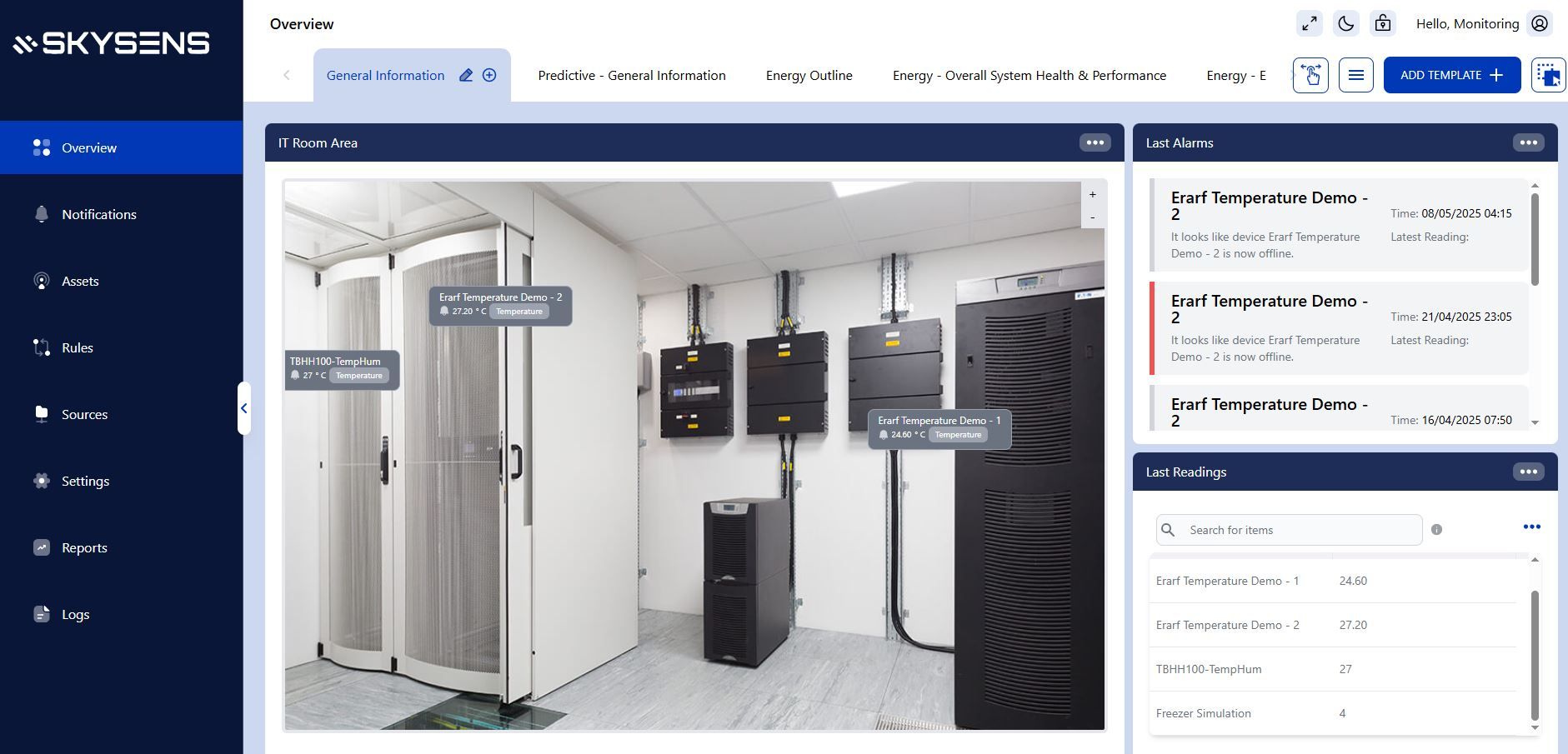
Wireless AgPM vs. Standard IT Monitoring
The disparity between a wireless AgPM solution and standard monitoring systems is clear, particularly in terms of temperature and environmental control.
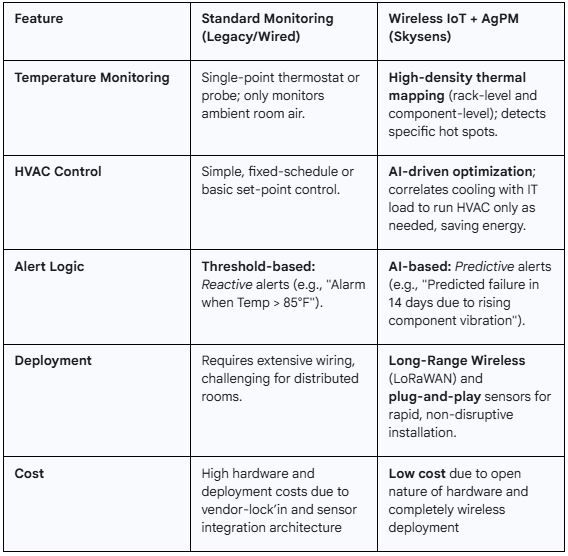
By decoupling monitoring from the physical constraints of cabling and integrating it with predictive intelligence, Wireless AgPM offers enterprises the agility and foresight needed to manage complex, distributed IT infrastructure efficiently, securely, and proactively.