The End of Inefficiency: How Skysens' AI-Powered Ambient Control is Revolutionizing Ambient Control for Industry

For industrial companies, the factory floor is a complex ecosystem where precision is paramount. Yet, one of the most critical and often overlooked factors impacting quality, efficiency, and cost is the ambient environment itself. Managing temperature and humidity across vast, dynamic industrial and technical spaces is a persistent challenge. Traditional control systems are frequently inefficient, leading to wasted energy, inconsistent conditions, and a direct negative effect on product quality and machine performance. These legacy solutions often require massive capital investment and lack the sensitivity to adapt to real-world factory dynamics.
A new paradigm is emerging, one that replaces costly, rigid infrastructure with an agile, intelligent, and predictive approach. Skysens is at the forefront of this transformation, leveraging a powerful combination of wireless sensor technology and deep learning to deliver a smart ambient control system that is not only highly effective but also seamlessly integrates with existing operations.
The Problem with the Old Guard: Why Traditional HVAC Fails?

Historically, factories have relied on a patchwork of solutions for environmental control. These typically fall into a few categories, each with significant drawbacks:
- Localized PLC-Based Control:
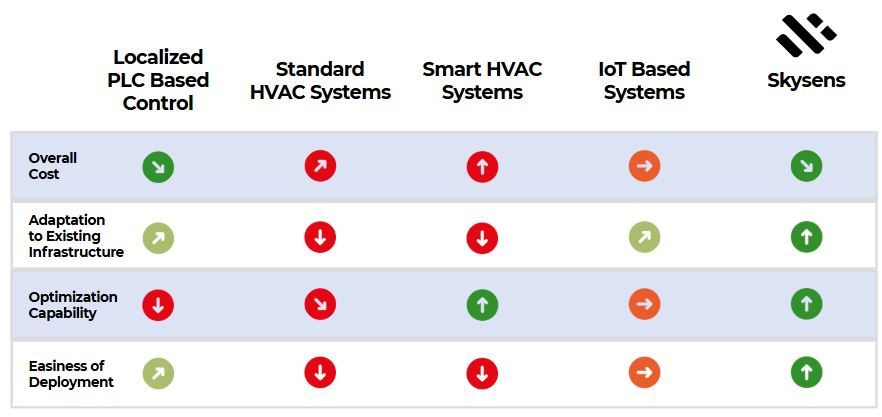
These systems operate in silos, managing individual zones without a holistic view of the entire facility. They lack the intelligence to coordinate and optimize, leading to energy waste and temperature and humidity inconsistencies.
- Standard HVAC Systems:
While capable of heating and cooling, these systems are often "dumb," running on simple timers or basic thermostat readings. They cannot account for external factors like weather, or internal dynamics like machine activity or personnel density.
- Wired Sensor Networks:
The traditional approach to data collection involves extensive and expensive wiring. This makes deployment slow and costly, and adapting the system to changing factory layouts is a major undertaking.
These methods are fundamentally reactive, not predictive. They are a brute-force solution to a nuanced problem, resulting in high operational costs and suboptimal performance.
The Skysens Revolution: Intelligent, Wireless, and Predictive
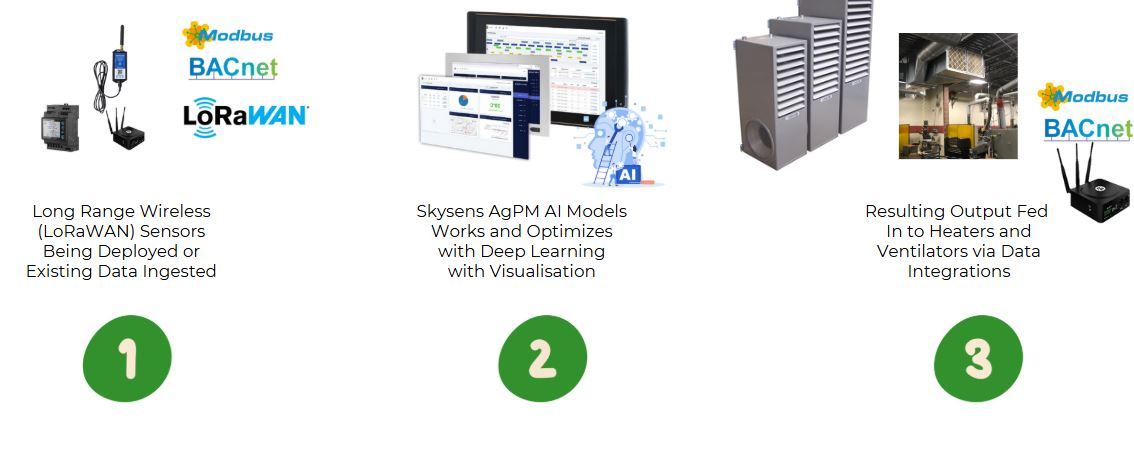
Skysens' Agile Predictive Monitoring (AgPM) platform introduces a smarter, more adaptable solution built on two core technological pillars : wireless IoT and deep learning AI.
1. Agile Data Collection with Wireless Sensors:
The foundation of any intelligent system is data. Skysens liberates data collection from the constraints of physical wiring. The system uses completely wireless, battery-powered, low-cost sensors that can be deployed effortlessly throughout a facility. These sensors utilize LoRaWAN, a long-range, low-power wireless protocol ideal for sprawling industrial environments, capable of covering areas up to 500 meters or spanning 4-5 floors with a single gateway. This wireless approach drastically reduces deployment time and cost, allowing for a dense and flexible sensor network that can be easily reconfigured as operational needs change.With different sensor selections this network can monitor not just temperature and humidity, but also energy consumption, equipment status (on/off),activity and material flow. Wireless technology also means physical deployment is fast and inexpensive and cover any area inside the facility without data communication issue with long battery life (up to 10 years)
2. Deep Learning for True Optimization:
This is where Skysens truly differentiates itself. The platform’s optimization engine is powered by deep learning algorithms, a sophisticated form of artificial intelligence. Unlike basic systems that simply react to a temperature threshold, Skysens' AI builds a comprehensive understanding of the facility's thermal dynamics. It contextualizes real-time sensor data by integrating it with third-party information, such as weather forecasts, energy price data, and even production schedules from ERP systems.
This allows the AI to move beyond simple reactions and make predictive decisions. The platform can be configured to optimize for different goals:
Maximum Energy Efficiency: The AI will determine the most cost-effective way to maintain an acceptable temperature range, potentially pre-heating or cooling during off-peak energy hours.
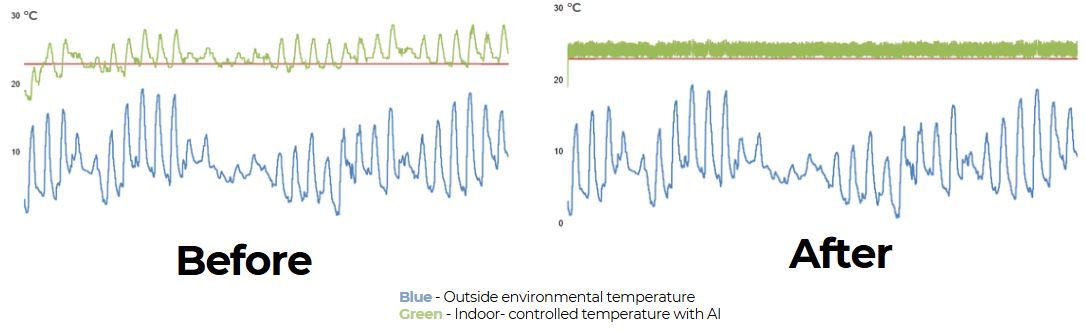
Strict Temperature or Humidity Stability: For processes highly sensitive to fluctuations, the AI will prioritize maintaining a precise temperature, minimizing any deviation from the target.
Reduced Variance: The system can focus on eliminating hot and cold spots, humid and dry areas, ensuring a homogenous environment across the entire area.
Balanced Optimization: The AI can find the optimal balance between all these factors to meet specific operational needs.
The results are dramatic, with demonstrated improvements of up to 95% less deviation from target temperatures, an 80% reduction in variance, and significant energy savings.
Seamless Integration and Actionable Intelligence
Recognizing that factories are complex environments with established infrastructure, Skysens is designed for integration, not replacement. The AgPM platform can communicate bi-directionally and securely with existing legacy systems, including SCADA, PLCs, and industrial computers, using standard protocols like Modbus, MQTT, and OPC UA. The optimized commands from the Skysens AI are fed directly back into the existing heaters, coolers, and ventilation equipment, making them smarter without the need for a costly hardware overhaul.
Furthermore, Skysens employs "AI Agents" that translate complex data into actionable, natural language insights for personnel. For example, a predictive maintenance agent can alert staff to a machine's anomalous vibrations and provide recommendations, acting as a virtual specialist. An energy agent can identify specific equipment that is consuming abnormal amounts of power and suggest corrective actions. This makes the powerful analytics of the system accessible to the entire operational team.
Proof in Practice: A Chemical Factory
The transformative power of Skysens' approach is validated by its award-winning implementation at a chemical factory in western Turkiye. Faced with an inflexible and inefficient heating infrastructure unable to provide a homogeneous environment for its quality-sensitive production processes, undisclosed customer turned to Skysens.
By integrating the AgPM AI and wireless IoT technology and Skysens AI with the existing legacy system, the factory achieved drastic improvements without additional investment in HVAC hardware. The results included significant gains in energy efficiency, better product quality, improved asset performance, and enhanced health and safety conditions for workers.

Conclusion: The Future of the Smart Factory is Here
The Skysens AgPM platform represents a leap forward in industrial environmental management. By combining the agility of wireless IoT with the predictive power of deep learning, it solves the core challenges that have plagued manufacturers for decades. It is a low-cost, high-impact solution that can be deployed without significant capital expenditure, offering a clear and rapid return on investment. For any large-scale manufacturing operation looking to boost efficiency, improve quality, and drive down costs, the Skysens approach is not just a compelling option—it is the future.